

The GMAT was completely overhauled in 2024, and most guides online still describe the old version. If you’ve been Googling “what is the GMAT” and found conflicting information about sections, scores, and test length, that’s why.
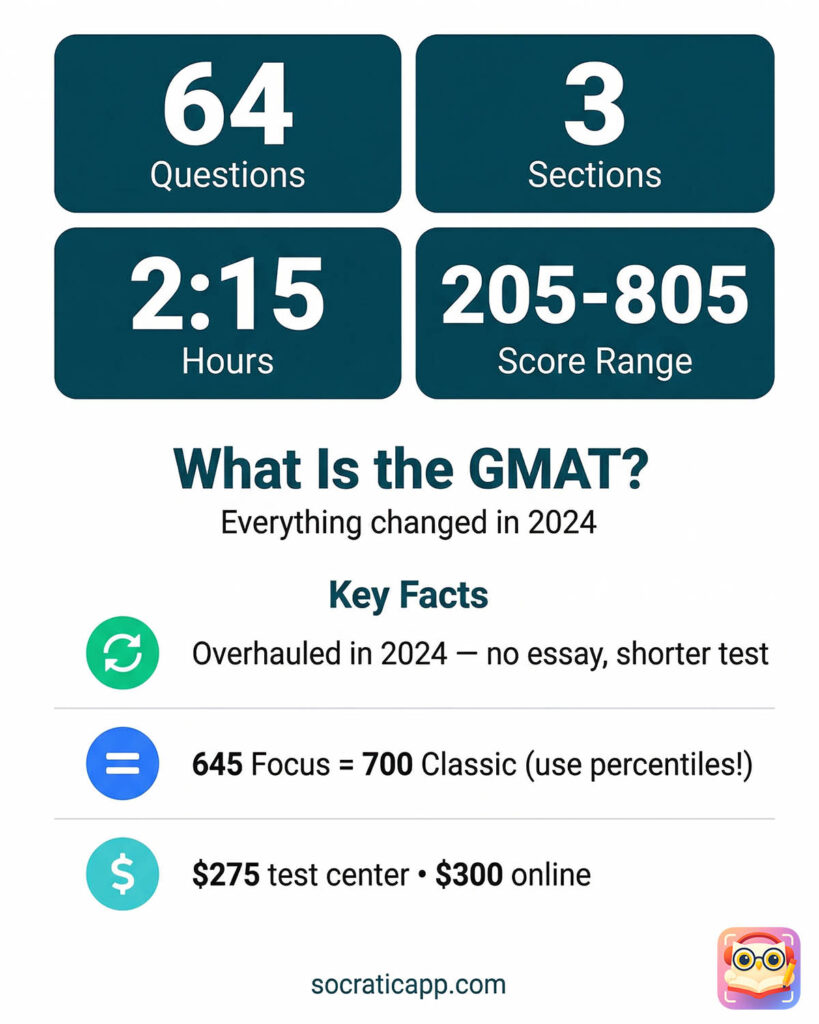
The Graduate Management Admission Test is a standardized exam administered by GMAC (Graduate Management Admission Council). It’s the primary admissions test for MBA and graduate business programs, accepted by over 7,700 programs at 2,400+ schools across 114 countries. The current version runs 2 hours and 15 minutes, covers 3 sections totaling 64 questions, and scores on a 205 to 805 scale.
I’ll walk you through exactly how it works, what scores you actually need, what it costs beyond the registration fee, and whether you should even take it. With 16 of the top 25 business schools now offering test waivers, not every applicant needs the GMAT. I’ll cover that decision too.
Quick Summary
| Detail | Current GMAT |
|---|---|
| Administered by | GMAC |
| Sections | 3: Quantitative Reasoning, Verbal Reasoning, Data Insights |
| Total questions | 64 |
| Test duration | 2 hours 15 minutes |
| Score range | 205 to 805 (10-point increments) |
| Cost | $275 (test center) / $300 (online) |
| Score validity | 5 years |
| Retake limit | 5 per year, 8 lifetime |
Table of Contents
- What Changed With the GMAT in 2024
- How the GMAT Works: Sections, Timing, and the Adaptive Algorithm
- GMAT Scores: What the Numbers Mean and What Schools Expect
- What the GMAT Actually Costs
- How to Prepare for the GMAT
- When the GMAT Might Not Be the Right Choice
- FAQ
Key Takeaways
- The GMAT changed significantly in 2024. The essay, Sentence Correction, and most geometry were removed. A new Data Insights section was added. Total test time dropped from 3+ hours to 2 hours 15 minutes.
- Score scales are different now. A 645 on the current GMAT equals roughly a 700 on the old “Classic” scale. Don’t compare raw numbers across versions — use percentiles instead.
- You might not need it at all. 16 of the top 25 US business schools offer test waivers, though 6 of 7 M7 programs still require scores.
- A strong score pays for itself. Scoring 685+ (96th percentile) strengthens merit scholarship candidacy. At 705+, you’re in elite scholarship territory.
- Budget more than the sticker price. The $275 registration fee is just the starting point. A realistic first-attempt budget is $400 to $600 with self-study; $1,000+ if you need a course or retake.
- The GRE is a legitimate alternative. 42 to 44% of HBS, Stanford, and Booth’s Class of 2027 submitted GRE scores. Take a practice test of each and go with your stronger result.
What Changed With the GMAT in 2024
If you’ve found conflicting details (four sections versus three, a 200 to 800 scale versus 205 to 805, test times of three hours versus two), here’s why: the exam you’ll take today is fundamentally different from the one in older guides. So what is the GMAT now, exactly?
The GMAT Focus Edition launched on November 7, 2023. It became the only available version on February 1, 2024. GMAC dropped the “Focus Edition” label on July 1, 2024, so it’s now just called “the GMAT.”
What was removed: The Analytical Writing Assessment (the essay), the standalone Integrated Reasoning section, all Sentence Correction questions, and most geometry. Test duration dropped from 3 hours and 7 minutes to 2 hours and 15 minutes.
What was added: A new Data Insights section that blends data analysis with the old IR-style question formats. You now choose the order you take the three sections. And a Question Review & Edit feature lets you bookmark and change up to 3 answers per section.
The score conversion trap: Schools reporting average GMAT scores of “700” are almost certainly using the old scale. On the current scale, a 645 equals a 700 Classic (both land around the 86th to 88th percentile). Quick conversion reference:
- 555 Focus = roughly 600 Classic
- 645 Focus = roughly 700 Classic
- 685 Focus = roughly 740 Classic
The net effect? A shorter test with fewer question types, harder quant, easier verbal, a brand-new data section, and a different score scale.
How the GMAT Works: Sections, Timing, and the Adaptive Algorithm
The GMAT doesn’t just measure what you know. It adapts to how you perform in real time, adjusting difficulty question by question. Most guides list the three sections and stop there. Here’s what actually happens under the hood.
Section Breakdown
| Section | Questions | Time | Calculator | What It Tests |
|---|---|---|---|---|
| Quantitative Reasoning | 21 | 45 min | No | Problem-solving, arithmetic, algebra, word problems. No geometry, no data sufficiency. |
| Verbal Reasoning | 23 | 45 min | No | Reading comprehension and critical reasoning. No sentence correction. |
| Data Insights | 20 | 45 min | Yes | Data Sufficiency (~5-7 Qs), Graphics Interpretation, Table Analysis (~3 Qs), Two-Part Analysis, Multi-Source Reasoning. |
Totals: 64 questions, 2 hours 15 minutes. One optional 10-minute break between any two sections. You pick the section order.
How the Adaptive Algorithm Scores You
Understanding what is the GMAT’s adaptive engine helps explain why strategy matters as much as knowledge. The test is computer-adaptive (CAT), constantly recalibrating based on your answers.
- Your first question arrives at medium difficulty.
- Answer correctly, and the next question gets harder. Answer wrong, and it gets easier.
- Early in each section, the algorithm swings aggressively. As few as 4 questions can push you to the highest or lowest difficulty band.
- Later questions fine-tune your score estimate with smaller adjustments.
- Your final score reflects both the number of questions you answered correctly AND the difficulty level you reached.
Medium-difficulty questions carry disproportionate weight. Missing one causes a significant hit to your score because it signals the algorithm to pull you down from a higher band. Hard questions, by contrast, are comparatively safe to miss because everyone misses some at the top.
Features That Change Your Strategy
The Question Review & Edit feature gives you 3 bookmarks per section. If you’re uncertain about a question, mark it and come back if time remains. Use all 3 slots.
Section order choice matters too. Starting with your strongest section builds confidence and sharpens focus for the remaining two.
Budget your time carefully: roughly 2 minutes and 8 seconds per question in Quantitative and Verbal Reasoning, and 2 minutes 15 seconds per question in Data Insights. Don’t rush early questions. They set the difficulty trajectory for your entire section.
GMAT Scores: What the Numbers Mean and What Schools Expect
Here’s exactly what scores you need, broken down by school tier with current Focus Edition numbers. Knowing what is the GMAT score you’re aiming for makes every prep decision easier.
Score Scale Basics
Total scores range from 205 to 805 in 10-point increments. Each section scores 60 to 90 in 1-point increments. The global average sits around 553 to 555.
Percentile Benchmarks
| Score (Focus Edition) | Percentile | What It Means |
|---|---|---|
| 555 | ~50th | Average test-taker |
| 605 | ~68th | Competitive for many programs |
| 635 | ~80th | Strong for top 50 schools |
| 645 | ~88th | Competitive for top 25 |
| 685 | ~96th | Elite; competitive for M7 |
| 705 | ~98th | Scholarship territory |
What Top Schools Actually Require
M7 programs (HBS, Stanford, Wharton, Booth, Kellogg, Sloan, Columbia): Averages cluster between 670 and 690 on the Focus Edition, equivalent to roughly 725 to 740 Classic. Columbia leads at approximately 690. HBS and Stanford report medians around 685. All seven M7 schools require test scores with no waiver option.
T15 programs (Tuck, Haas, Yale SOM, Ross, Stern, Darden): Averages range from 665 to 682. Some of these schools, including NYU Stern, Ross, Darden, and Cornell Johnson, offer test waivers for qualified applicants.
Scholarship positioning: Scoring 685+ (96th percentile) strengthens merit aid candidacy at most programs. At 705+ (98th percentile), you’re in elite scholarship territory. A 10 to 20 point improvement can translate to tens of thousands of dollars in additional funding.
A Caveat on Reported Averages
Schools are split between reporting mean and median scores after changes to U.S. News ranking methodology. Stanford and HBS report medians (~685). Columbia reports a mean (~690). Always check whether a school is reporting mean or median before benchmarking your own score.
GMAT scores remain valid for 5 years from the test date, and old Classic GMAT scores are still accepted within their validity window.
What the GMAT Actually Costs
The GMAT registration fee is $275. The actual cost of taking the GMAT? Plan for significantly more. Understanding what is the GMAT’s true price tag prevents budget surprises.
Registration Fees
- In-person (test center): $275
- Online: $300
- Both include score sends to 5 schools
Rescheduling Fees
| Timing | In-Person | Online |
|---|---|---|
| 60+ days before exam | $55 | $60 |
| 15-60 days before | $110 | $120 |
| Fewer than 14 days | $165 | $180 |
Cancellation refunds are equally steep. Cancel 60+ days out and you get $110 back.
Cancel within 24 hours of the test? Zero refund, the full $275 is gone.
Beyond Registration
- Extra score reports: $35 each (beyond the 5 included)
- Retakes: Full registration fee every time (up to 5 per year, 8 lifetime)
- Prep materials: Official Guide runs $35 to $50, online courses range from $99 to $1,999, and private tutoring starts around $150 per hour
Realistic Budget Scenarios
| Scenario | Breakdown | Total |
|---|---|---|
| Minimal (self-study, one attempt) | $275 registration + $50 Official Guide | ~$325 |
| Moderate (online course, one attempt) | $275 + $50 + $150 course + $35 extra reports | ~$510 |
| Full investment (premium course, one retake) | $300 + $50 + $1,000 course + $275 retake + $70 reports | ~$1,695 |
Budget $400 to $600 as a realistic baseline for one attempt with self-study. If you need a prep course or anticipate a retake, plan for $1,000 or more. The rescheduling fees are the most frustrating hidden cost. Book your test date only when you’re genuinely ready.
How to Prepare for the GMAT
Here’s a concrete prep framework in four steps, built for people juggling full-time jobs. Knowing what is the GMAT testing helps you study smarter, not just harder.
Step 1: Establish Your Baseline
Take the 2 free official GMAT practice tests on mba.com. These use actual retired exam questions and provide the most accurate score prediction available. Identify your starting score and which sections need the most work. This takes one weekend.
Step 2: Set Your Target
Use the school tier benchmarks above. Calculate the gap between your baseline and your target score. Rough hour estimates for improvement:
- 30-point gain: ~50 hours of focused study
- 50+ point gain: 80 to 100 hours
- 100+ point gain: 150+ hours
Step 3: Build Your Timeline
- 3-month sprint: 12 to 20 hours per week. Best if your baseline is within 50 points of your target.
- 5-month standard: 8 to 12 hours per week. Realistic for most working professionals.
- 6-month extended: 6 to 8 hours per week. Sustainable but demands discipline.
The daily rhythm that works for most people: 30 to 90 minutes on weekdays, longer sessions on weekends. Take a full practice test every 2 to 3 weeks to track progress.
Step 4: Choose Resources by Budget
- Free: GMAT Club forum (question bank + community), 2 free official practice exams, YouTube channels.
- Budget ($50 to $200): GMAT Official Guide ($35 to $50) + Magoosh ($149 for 6 months). Best value for most test-takers.
- Mid-range ($200 to $500): Target Test Prep (~$99/month) or Manhattan Prep self-paced. Strong choice for quant improvement.
- Premium ($500 to $2,000): Manhattan Prep or Princeton Review full courses. Best for structured learners who want classroom-style instruction.
Final Two Weeks
Taper your studying. Focus only on weak spots. Take one last practice test to confirm you’re consistently at or above your target. Register for the real exam only after hitting that threshold.
I’d recommend starting with the Official Guide and the 2 free practice tests regardless of your budget. That combination tells you whether you can self-study or need a course.
When the GMAT Might Not Be the Right Choice
Not everyone needs the GMAT. Understanding what is the GMAT’s role in your specific application starts with three questions: do your target schools require it, would your score help or hurt, and is the GRE a better fit?
The Test-Optional Landscape
Sixteen of the top 25 US business schools now offer GMAT/GRE waivers. That sounds like a lot, but 6 of 7 M7 programs still require scores. Waiver eligibility typically demands 5+ years of analytical work experience, a CPA or CFA certification, or a graduate degree in a quantitative field.
The Waiver Trade-Off
A waiver may hurt your scholarship chances. Schools including UW Foster, Texas McCombs, UVA Darden, and Carnegie Mellon Tepper explicitly state that strong test scores improve scholarship opportunities. If you can score well, submitting beats waiving.
GMAT vs. GRE
Every top MBA program now accepts both tests. The GRE accounts for 37.2% of submissions at top 10 programs, up from 31.1% two years ago. At HBS, Stanford, and Booth, 42 to 44% of the Class of 2027 submitted GRE scores.
Take a practice test of each and go with whichever yields the higher percentile. GMAT quant better represents business school math. GRE verbal favors strong readers.
When to Skip the GMAT Entirely
- All your target programs offer waivers AND you have strong quantitative credentials.
- Your projected score would fall below the school’s average (a below-average score can hurt more than no score at all).
- The GRE fits your strengths better, or time constraints prevent adequate prep.
Take the GMAT if you’re targeting M7 or T15 programs, want to maximize scholarship eligibility, or your quant skills are strong. Consider alternatives if every school on your list accepts waivers and you already have quantitative credentials.
FAQ
How many times can I take the GMAT?
Up to 5 times within any 12-month rolling period and 8 times total in your lifetime. All versions (including the old Classic GMAT) count toward these limits. Each retake costs the full registration fee ($275 to $300). Schools generally consider your highest score.
How long are GMAT scores valid?
Scores are valid for 5 years from the test date. Classic GMAT scores from before February 2024 are still accepted within that 5-year window. Official scores are reported within approximately 7 business days.
Is the current GMAT harder than the old version?
It depends on the section. Verbal is easier because Sentence Correction was removed. Quant is harder, with more advanced problem-solving. Data Insights is harder than the old Integrated Reasoning.
Overall difficulty is comparable once you account for the recalibrated score scale. A 645 today equals a 700 on the old scale at roughly the same percentile.
Can I take the GMAT online?
Yes. The online version costs $300 (versus $275 for in-person) and is identical in content and scoring. You take it at home with a proctor monitoring through your webcam.
