

With over 150 hours researching and testing 15 of the best online learning platforms, our in-house experts and I have shortlisted our top five recommendations for 2026.
Khan Academy is our number one choice for the second year in a row, offering the strongest free curriculum available – particularly in math and science – along with an AI-powered tutor that genuinely teaches instead of just giving answers.
Our Top 5 Online Learning Platforms
- Khan Academy – Best free learning platform
- Coursera – Best for degrees and certificates
- Udemy – Best for affordable skills training
- edX – Best for university-level courses
- Skillshare – Best for creative learners
Comparing the Best Online Learning Platforms
Take a look at our top online learning platform picks side-by-side to see which best suits your needs:
| Platform | Best For | Starting Price | Free Option | AI Features |
|---|---|---|---|---|
| Khan Academy | Free learning (especially math) | Free | Full platform is free | Khanmigo AI tutor ($4/mo) |
| Coursera | Degrees & certificates | $49 per course | Free audit on many courses | AI-powered course recommendations |
| Udemy | Affordable skills training | ~$10 on sale | Some free courses | AI assistant for Q&A |
| edX | University-level courses | Free audit | Free audit on most courses | AI-driven learning paths |
| Skillshare | Creative & practical skills | $13.99/month | 7-day free trial | AI-powered recommendations |
#1. Khan Academy: Best Free Learning Platform
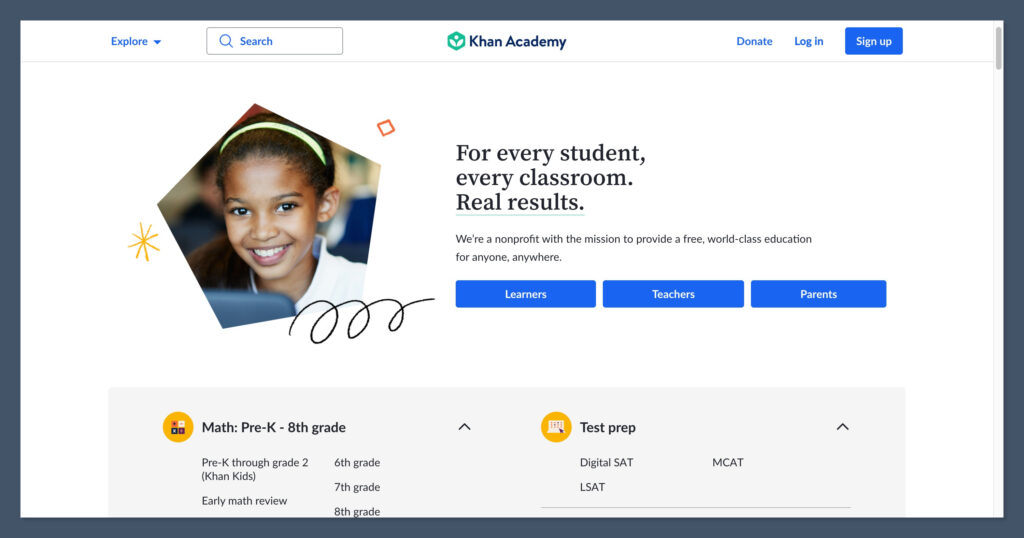
💰 Starting price: Free (Khanmigo AI tutor: $4/month)
🤖 AI features: Khanmigo conversational AI tutor
📱 Available on: Web, iOS, Android
Khan Academy is the best online learning platform I’ve tested, and it holds our top position for 2025.
As a nonprofit, Khan Academy offers its entire library of courses, practice exercises, and instructional videos completely free of charge. After spending weeks exploring its math curriculum in particular – from basic arithmetic through AP Calculus – I can see why it’s trusted by over 150 million learners worldwide.
The content is well-structured, the practice exercises are genuinely adaptive, and the addition of the Khanmigo AI tutor has transformed the platform into something that rivals paid alternatives.
✔️ Pros
- Entirely free – no ads, no paywalls
- Exceptional math and science curriculum (K-12 through college)
- Khanmigo AI tutor uses Socratic method to guide learning
- Personalized learning dashboard tracks progress
- Trusted by schools and districts worldwide
❌ Cons
- Limited advanced professional or niche content
- No formal accredited certificates or degrees
- Interface can feel busy for new users
- Khanmigo AI tutor is a paid add-on ($4/month)
In January 2026, Khan Academy expanded its partnership with Google to integrate the Gemini AI model into literacy tools.
Khanmigo’s math tutoring engine has also been upgraded to GPT-4 Omni, improving accuracy and conversational quality.
I tested Khan Academy’s math track most extensively, and I was impressed by how well the platform adapts to each learner’s level.
When I deliberately missed problems in algebra, the system immediately served up review exercises targeting my specific gaps.
The instructional videos are clear, concise, and well-paced – Sal Khan has a knack for making complex concepts feel approachable.
And with the Khanmigo AI tutor, the experience goes even further: instead of just serving up the answer, it asks guiding questions to lead you toward the solution yourself.
For parents and students looking for math support, Khan Academy is particularly strong. The K-12 math curriculum aligns with common national standards, and the practice exercises include thousands of problems with instant feedback. Common Sense Media rated Khanmigo as a top educational AI tool, and it scored high for safety, transparency, and learning quality.
How Much Does Khan Academy Cost?
- Khan Academy’s full platform is 100% free – no subscription required
- Khanmigo AI tutor costs $4 per month (or $44 per year) for learners and parents
- Teachers in the US get free access to Khanmigo tools
- Parents can add up to 10 children to a single Khanmigo subscription
Bottom Line: Should You Use Khan Academy?
Khan Academy offers the best value in online education – period. Its comprehensive curriculum, especially in math and science, is available to anyone for free.
The addition of Khanmigo brings genuine AI tutoring to the platform for the price of a coffee per month. Whether you’re a student brushing up on algebra, a parent supporting your child’s learning, or a teacher supplementing your classroom, Khan Academy delivers.
Khan Academy is suitable for:
- Students who need a strong math and science foundation
- Parents looking for a free, trusted educational resource
- Teachers who need tools to track student progress
Khan Academy isn’t suitable for:
- Professionals seeking accredited certificates or degrees
- Learners who want advanced niche or professional skills
- Users who prefer a more modern, polished interface
#2. Coursera: Best for Degrees and Certificates
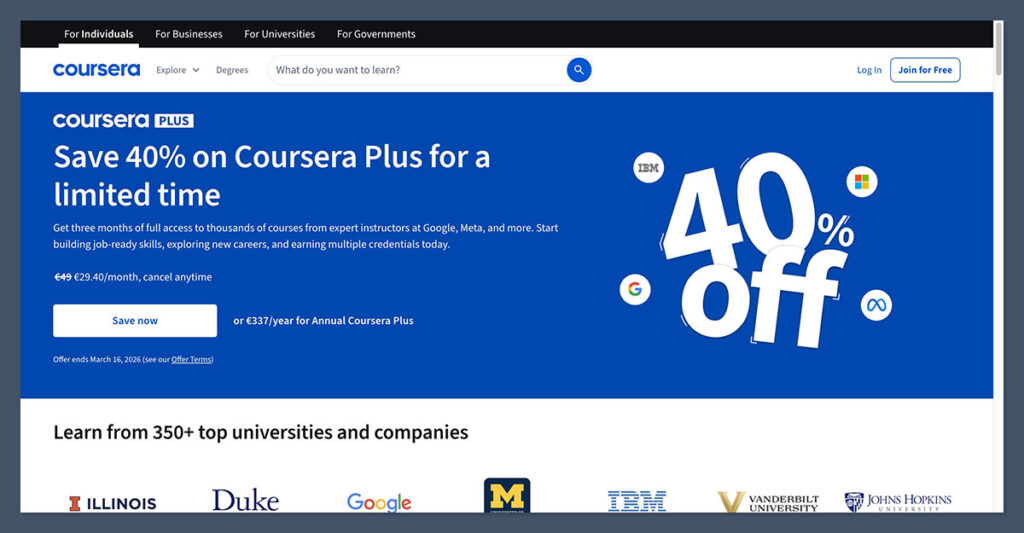
💰 Starting price: Free audit / $49 per course / $59/month for Coursera Plu
🤖 AI features: AI-powered course recommendations and learning coach
📱 Available on: Web, iOS, Android
According to our experts, Coursera remains the best platform for earning recognized credentials in 2025. Partnered with over 300 leading universities and companies – including Yale, Stanford, Google, and IBM – Coursera offers everything from free course audits to full accredited degrees.
From my testing, its structured learning paths and rigorous assessment methods set it apart from less formal alternatives.
If you’re looking for a credential that carries weight on a resume, Coursera is where you should start.
✔️ Pros
- Partnerships with 300+ top universities and companies
- Recognized professional certificates (Google, IBM, Meta)
- Accredited online degrees from leading universities
- Many courses can be audited for free
- Coursera Plus offers unlimited access to 7,000+ courses
❌ Cons
- Degree programs can be expensive ($9,000–$50,000+)
- Free audit mode limits access to graded work and certificates
- More structured and time-intensive than self-paced alternatives
- Coursera Plus doesn’t include degrees or MasterTrack programs
Coursera is currently offering a 40% discount on Coursera Plus for the first 3 months, bringing the monthly price down to $35.40. The platform has also expanded its AI learning coach feature across more courses.
I tested Coursera by enrolling in a data science specialization and auditing several individual courses.
The quality of instruction is consistently high – you can tell these are real university-level courses, complete with rigorous assignments and peer-reviewed projects.
The Google Professional Certificates in particular are excellent: they’re designed to get you job-ready in fields like data analytics, IT support, and project management, and they can be completed in under six months.
For math and STEM learners specifically, Coursera stands out with its depth. You can audit university-level math courses from institutions like MIT, Stanford, and Johns Hopkins, covering everything from calculus and linear algebra to statistics and machine learning.
If you’re beyond the foundational level that Khan Academy covers and want something with academic rigor and a recognized credential, Coursera is the natural next step.
How Much Does Coursera Cost?
- Individual courses range from free (audit) to approximately $49–$99 for a certificate
- Specializations and Professional Certificates cost $49 per month
- Coursera Plus costs $59 per month or $399 per year (unlimited access to 7,000+ courses)
- Online degrees range from $9,000 to $50,000+
- Financial aid is available for eligible learners
Bottom Line: Should You Use Coursera?
Coursera is the gold standard for online credentials. Its university partnerships and professional certificate programs are recognized by employers worldwide, and the ability to audit courses for free means you can try before you commit.
For serious career changers and students who want a credential that matters, Coursera delivers quality that justifies its price.
Coursera is suitable for:
- Career changers who need recognized certificates
- Students pursuing affordable online degrees
- Professionals upskilling in data science, tech, or business
Coursera isn’t suitable for:
- Casual learners who just want to browse topics
- Users who want completely free access with no restrictions
- Learners looking for creative or hobby-based courses
#3. Udemy: Best for Affordable Skills Training
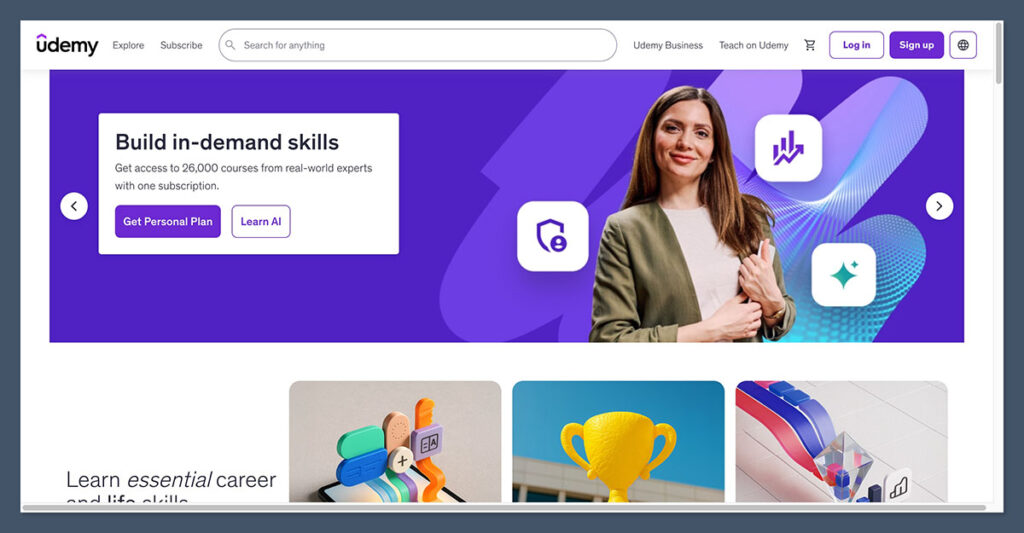
💰 Starting price: ~$10–$15 on sale (regular prices up to $199)
🤖 AI features: AI assistant for Q&A, personalized recommendations
📱 Available on: Web, iOS, Android
Udemy is our expert recommendation for anyone who wants affordable, flexible skills training across virtually any topic.
With over 200,000 courses on the platform, Udemy operates as an open marketplace – meaning anyone can create and sell a course, which keeps prices low and topic coverage incredibly broad.
I found that during Udemy’s frequent sales (which happen almost constantly), most courses drop to $10–$15, making it one of the most budget-friendly ways to learn new skills online.
✔️ Pros
- Massive catalog of over 200,000 courses
- Very affordable during frequent sales ($10–$15 per course)
- Covers virtually every topic imaginable
- Lifetime access to purchased courses
- 30-day money-back guarantee
❌ Cons
- Quality is inconsistent across the marketplace
- Certificates are not widely recognized academically
- No structured learning paths or degree programs
- Full prices ($50–$199) are rarely worth paying
When testing Udemy, I enrolled in several math and programming courses to assess quality.
The experience varies widely – some instructors are fantastic, with clear explanations and well-structured content, while others fall short. The key is to check ratings and reviews before purchasing.
Courses with 4.5+ stars and thousands of reviews are generally reliable. I found some excellent math courses covering topics from statistics to calculus at a fraction of what you’d pay on other platforms.
Udemy’s biggest advantage is its pay-per-course model with lifetime access. Unlike subscription platforms, you buy a course once and keep it forever, which is ideal for self-paced learners who might return to material over time.
The platform also offers Udemy Business for corporate training, which provides a curated library of high-quality courses with analytics and admin tools for companies.
How Much Does Udemy Cost?
- Individual courses range from $10–$15 on sale (sales run almost constantly)
- Regular prices range from $20 to $199, but sales are the norm
- Purchased courses include lifetime access
- Udemy Business starts at $30 per user per month for teams
- Some free courses are available on the platform
Bottom Line: Should You Use Udemy?
Udemy is the most affordable way to learn practically any skill online. Its marketplace model means you’ll need to be selective about course quality, but when you find a great instructor, the value is unbeatable.
If you’re looking for flexible, budget-friendly learning across a wide range of topics, Udemy is hard to beat – just make sure to buy during a sale.
Udemy is suitable for:
- Budget-conscious learners who want affordable courses
- Self-paced learners who value lifetime access
- Anyone looking to explore a wide range of topics
Udemy isn’t suitable for:
- Learners who need recognized academic credentials
- Users who want guaranteed course quality without research
- Students looking for structured degree programs
#4. edX: Best for University-Level Learning
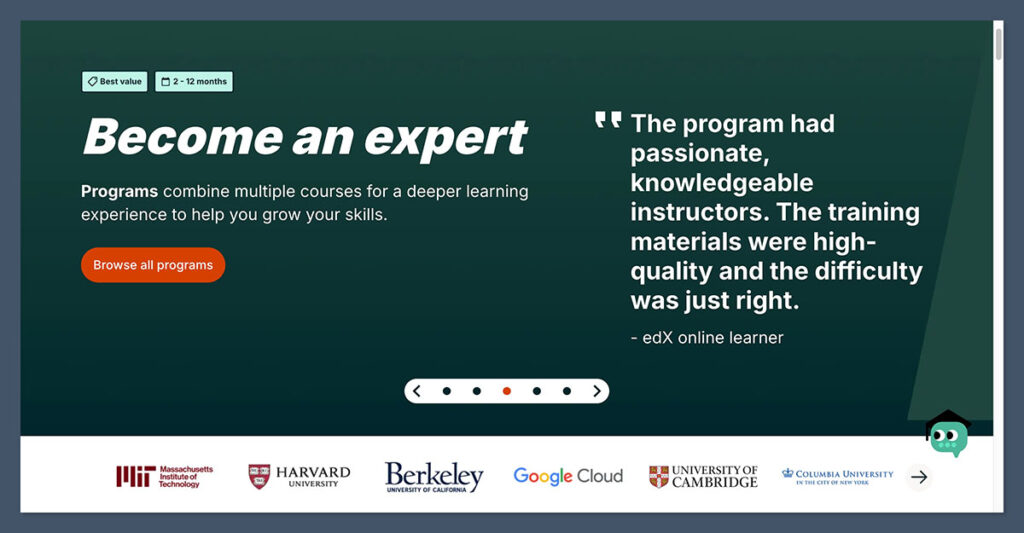
💰 Starting price: Free audit / Certificates from ~$50–$300
🤖 AI features: AI-driven learning paths and Xpert chatbot
📱 Available on: Web, iOS, Android
If you want the rigor of a university course without the university price tag, edX is the platform I recommend. Founded by Harvard and MIT, edX partners with over 160 universities to offer courses that match the depth and quality of on-campus learning.
The platform is particularly generous with free access – most courses can be fully audited at no cost, including lectures, readings, and some practice exercises.
You only pay if you want a verified certificate or access to graded assignments.
✔️ Pros
- Founded by Harvard and MIT with 160+ university partners
- Many courses can be fully audited for free
- MicroMasters and MicroBachelors programs that count toward degrees
- Strong STEM and math course catalog
- Executive education programs for professionals
❌ Cons
- Limited access to graded work on free audit track
- No certificate without payment
- Interface can feel academic and less polished than competitors
- Some programs have fixed start dates
I tested edX by auditing several math and computer science courses from MIT and Harvard. The academic quality is outstanding – these are genuine university-level courses with challenging problem sets and in-depth lectures.
For math specifically, edX offers some of the best calculus, linear algebra, and statistics courses available online, taught by professors from institutions that literally wrote the textbook.
What I particularly like about edX is its MicroMasters programs. These are graduate-level course sequences that can count as credit toward a full master’s degree if you’re accepted into a participating university’s program.
It’s a powerful pathway for learners who want to test the waters of graduate education before committing fully.
Similarly, the MicroBachelors programs offer undergraduate-level credential building that can stack toward a bachelor’s degree.
How Much Does edX Cost?
- Audit most courses for free (lectures, readings, some exercises)
- Verified certificates range from approximately $50 to $300
- MicroMasters programs cost $600–$1,500 total
- Professional certificate programs range from $200–$1,000
- Full online degrees start at $10,000+
Bottom Line: Should You Use edX?
edX offers the most generous free access to genuine university-level content of any platform on this list.
Its partnerships with Harvard, MIT, and other top universities give it unmatched academic credibility, and its MicroMasters pathway is a smart way to build toward a graduate degree.
For STEM and math learners in particular, edX provides depth and rigor that few other platforms can match.
edX is suitable for:
- Learners who want university-level academic rigor
- Students exploring a path to graduate education
- STEM and math learners seeking deep, challenging content
edX isn’t suitable for:
- Casual learners who want light, hobby-style content
- Users who need a fully free certificate
- Learners who prefer a more modern, interactive experience
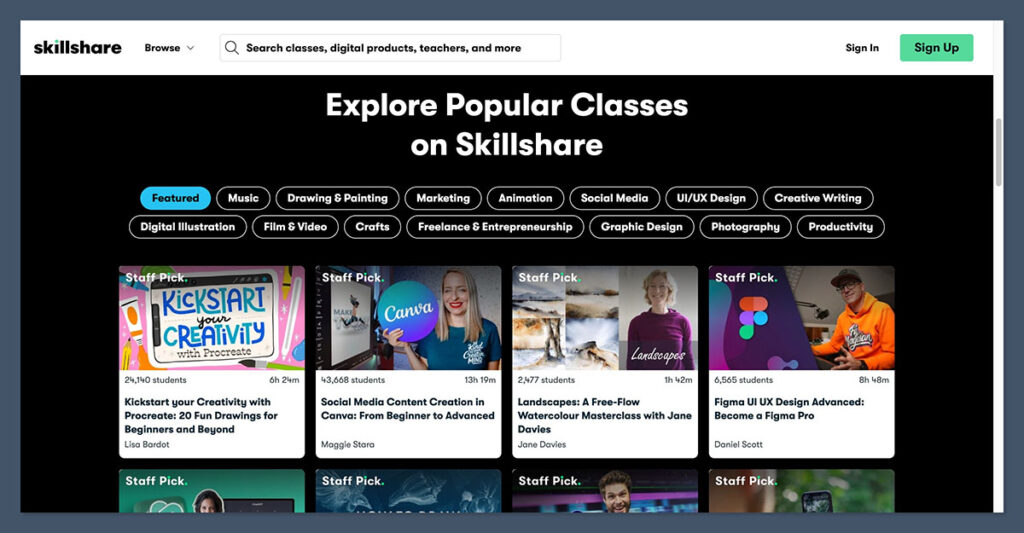
#5. Skillshare: Best for Creative Learners
💰 Starting price: $13.99 per month (billed annually)
🤖 AI features: AI-powered course recommendations
📱 Available on: Web, iOS, Android
Our expert research team recommends Skillshare for anyone who wants to explore creative and practical skills in a project-based learning environment.
Unlike the academic focus of Coursera or edX, Skillshare is built around hands-on, project-driven classes in design, illustration, photography, content creation, and more.
The subscription model gives you unlimited access to the entire catalog, which makes it great for curious learners who want to explore different topics without committing to individual course purchases.
✔️ Pros
- Project-based classes that encourage doing, not just watching
- Strong in creative niches (design, illustration, writing, photography)
- Unlimited access to full catalog with subscription
- Great for discovering new interests and hobbies
- Active community of creators sharing projects
❌ Cons
- No formal certificates or credentials
- No university partners or academic backing
- Limited STEM and math content
- Quality varies across the marketplace
When testing Skillshare, I focused on courses in data visualization, productivity, and logic – areas where creative and analytical thinking overlap.
While Skillshare isn’t the place for deep math learning, its project-based approach is genuinely engaging.
Each class typically includes a hands-on project, which forces you to apply what you’ve learned rather than passively watching videos.
For learners who are strong in STEM but want to develop complementary creative skills, Skillshare fills a gap that academic platforms don’t address.
Skillshare’s subscription model is straightforward: one monthly or annual fee gives you access to everything. There’s no upselling for individual courses or certificates.
This makes it ideal for exploratory learners who might take a class on illustration one week and graphic design the next. The 7-day free trial lets you test the experience before committing.
How Much Does Skillshare Cost?
- Skillshare costs $13.99 per month when billed annually
- Monthly billing is $32 per month
- A 7-day free trial is available for new users
- The subscription includes unlimited access to the full catalog
- Some free classes are available without a subscription
Bottom Line: Should You Use Skillshare?
Skillshare is the best platform for creative, project-based learning. It won’t replace an academic platform like Coursera or a math-focused tool like Khan Academy, but it fills an important gap for learners who want to develop practical creative skills alongside their technical education.
The subscription model offers excellent value for curious, multi-interest learners.
Skillshare is suitable for:
- Creative learners interested in design, writing, and visual arts
- Curious explorers who want to try different topics
- Users who prefer project-based, hands-on classes
Skillshare isn’t suitable for:
- Learners who need recognized academic credentials
- Students focused on math, science, or test prep
- Users who want in-depth, structured learning paths
How To Choose the Right Online Learning Platform
Whether you’re exploring online learning for the first time, or you want to switch from your current platform to another, you need to figure out what to look out for.
While we can help you compare platforms, you have to determine your needs and must-haves, and identify what you can live without.
Below, I’ve put together a checklist of key factors to consider when researching or trialing an online learning platform:
- Content quality and depth: Are courses taught by qualified instructors? Are there university or industry partnerships that vouch for the content? Is the material rigorous enough for your goals?
- Credential value: Do you need a certificate or degree that employers will recognize? Free platforms like Khan Academy are great for learning, but won’t give you a resume-ready credential the way Coursera or edX can.
- AI and personalization: Does the platform adapt to your learning level? AI-powered features like Khanmigo’s Socratic tutoring or Coursera’s learning coach can significantly improve the experience.
- Pricing and accessibility: What’s the cost structure? Can you audit courses for free? Is there a subscription model or do you pay per course? Check for financial aid options if budget is a concern.
- Subject coverage: Does the platform cover what you need to learn? Some platforms excel in STEM (Khan Academy, edX), while others are stronger in creative or professional skills (Skillshare, Udemy).
- Learning format: Do you prefer self-paced or scheduled courses? Video lectures or interactive exercises? Project-based or exam-based? Match the format to your learning style.
- Mobile access: Can you learn on the go? All of our top picks offer mobile apps, but the quality of the mobile experience varies between platforms.
- Community and support: Does the platform offer discussion forums, peer interaction, or instructor support? Community features can make a big difference in staying motivated.
How We Test Online Learning Platforms
Our Testing Methodology
This year, we put 15 leading online learning platforms through an in-depth testing process to determine our ranking and recommendations.
Our research team has spent over 150 hours analyzing each platform, enrolling in real courses, and evaluating the learning experience from start to finish.
We’ve focused on six core categories – each category has been given a unique weighting to reflect what our readers value the most:
Content Quality and Partners: 30%
We examine the quality of course content, the credentials of instructors, and the strength of university and industry partnerships. We pay particular attention to STEM and math offerings, as these are central to our audience’s learning goals.
Learning Experience: 25%
We assess each platform’s teaching approach, including AI features, adaptive learning, interactivity, video quality, and the availability of practice exercises and assessments.
Credential Value: 15%
We evaluate how certificates, degrees, and credentials from each platform are perceived by employers and academic institutions. We look at recognition, stackability, and career impact.
Pricing and Accessibility: 15%
We review the pricing structure of each platform, including free options, subscription models, financial aid, and overall value for money compared to alternatives.
User Experience: 10%
We test each platform ourselves to assess navigation, mobile apps, onboarding, and the overall ease of getting started and staying on track.
Community and Support: 5%
We look at discussion forums, peer interaction, instructor availability, and customer support options.
My Online Learning Platform Testing Summary
After testing each of these platforms, I have my personal favorites (looking at you, Khan Academy and Coursera), but I stand by our 2026 rankings and recommendations.
And that’s what makes it so important to read through a list like ours – the perfect platform for one learner might not be the right fit for another, so it’s worth knowing what you need most and testing out each platform for yourself.
Khan Academy remains our champion because it’s difficult for any other platform to compete with the sheer quality and depth of its free curriculum – particularly in math and science.
I was really impressed by the Khanmigo AI tutor, since it transforms the experience from passive video-watching to active, guided learning.
Coursera and edX both deliver genuine university-level education, with Coursera leading on professional certificates and edX winning on free audit generosity.
And, while Udemy’s marketplace model means you have to be selective about quality, its unbeatable pricing makes it accessible to almost anyone.
Skillshare, on the other hand, fills a unique niche for creative and project-based learning that the academic platforms don’t address.
Key Takeaways
- Khan Academy is our top-rated platform – completely free with an AI tutor included
- Pricing ranges from free to $59 per month across our top recommendations
- All five platforms now offer AI-powered learning features
- Coursera is the best option if you want a recognized university credential
- The global online education market is projected around $342 billion in 2025, growing at roughly 15% per year
Final Verdict: Which Platform Do I Recommend?
Our research process has determined the top five online learning platforms for 2025, and Khan Academy is the best platform for foundational learning, especially in math and science.
It’s a genuine powerhouse, whether you’re brushing up on algebra or preparing for AP exams – and it’s completely free.
Each platform has its strengths – and weaknesses – so I know Khan Academy won’t be the right fit for everyone.
If you need a recognized credential for your career, Coursera is the clear choice. If you want deep university-level rigor with generous free access, go with edX.
If you’re after affordable, flexible skills training, Udemy delivers. And if you want to develop creative skills through hands-on projects, give Skillshare a try.
If you’re unsure of where to start, I recommend trying the free options first – Khan Academy is entirely free, Coursera and edX let you audit courses at no cost, and Udemy frequently runs sales that bring course prices down to under $15.
Test a few platforms to figure out what works best for your learning style and goals.
